“Hast thou entered into the springs of the sea?” - Job_38:16
Some things in nature must remain a mystery to the most intelligent and enterprising investigators. Human knowledge has bounds beyond which it cannot pass. Universal knowledge is for God alone. If this be so in the things which are seen and temporal, I may rest assured that it is even more so in matters spiritual and eternal. Why, then, have I been torturing my brain with speculations as to destiny and will, fixed fate, and human responsibility? These deep and dark truths I am no more able to comprehend than to find out the depth which coucheth beneath, from which old ocean draws her watery stores. Why am I so curious to know the reason of my Lord’s providences, the motive of his actions, the design of his visitations? Shall I ever be able to clasp the sun in my fist, and hold the universe in my palm? yet these are as a drop of a bucket compared with the Lord my God. Let me not strive to understand the infinite, but spend my strength in love. What I cannot gain by intellect I can possess by affection, and let that suffice me. I cannot penetrate the heart of the sea, but I can enjoy the healthful breezes which sweep over its bosom, and I can sail over its blue waves with propitious winds. If I could enter the springs of the sea, the feat would serve no useful purpose either to myself or to others, it would not save the sinking bark, or give back the drowned mariner to his weeping wife and children; neither would my solving deep mysteries avail me a single whit, for the least love to God, and the simplest act of obedience to him, are better than the profoundest knowledge. My Lord, I leave the infinite to thee, and pray thee to put far from me such a love for the tree of knowledge as might keep me from the tree of life.
St. Michael the Archangel
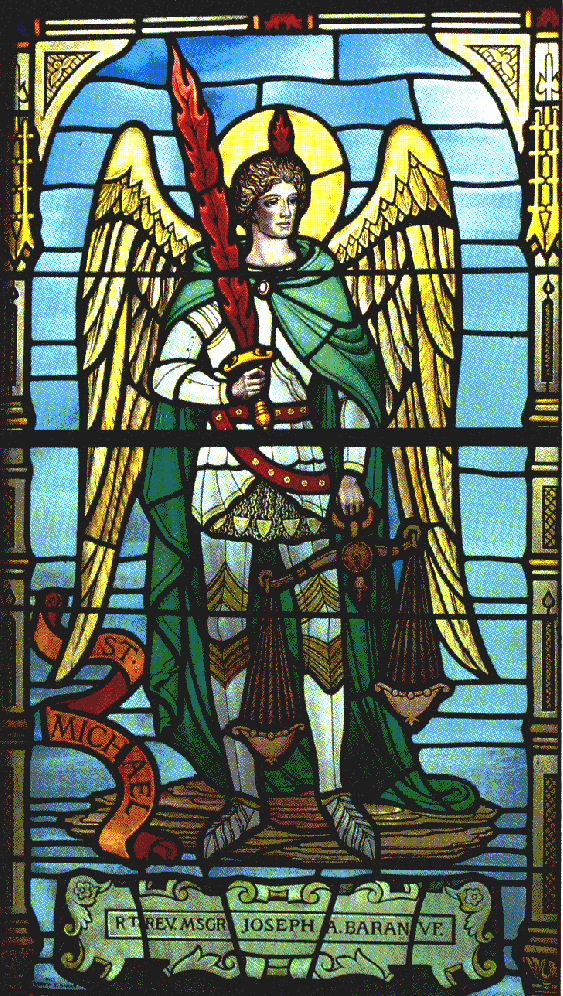
Patron Saint of Police Officers
Saturday, September 5, 2009
from the pen of Charles Spurgeon...

Monday, June 29, 2009
Wednesday, December 10, 2008
The Necklace
The cheerful little girl with bouncy golden curls was almost five. Waiting with her mother at the checkout stand, she saw them, a circle of glistening white pearls in a pink foil box.
'Oh mommy please, Mommy. Can I have them? Please, Mommy, please?'
Quickly the mother checked the back of the little foil box and then looked back into the pleading blue eyes of her little girl's upturned face.
'A dollar ninety-five. That's almost $2.00. If you really want them, I'll think of some extra chores for you and in no time you can save enough money to buy them for yourself. Your birthday's only a week away and you might get another crisp dollar bill from Grandma.'
As soon as Jenny got home, she emptied her penny bank and counted out 17 pennies. After dinner, she did more than her share of chores and she went to the neighbor and asked Mrs. McJames if she could pick dandelions for ten cents. On her birthday, Grandma did give her another new dollar bill and at last she had enough money to buy the necklace.
Jenny loved her pearls. They made her feel dressed up and grown up. She wore them everywhere, Sunday school, kindergarten, even to bed. The only time she took them off was when she went swimming or had a bubble bath . Mother said if they got wet, they might turn her neck green.
Jenny had a very loving daddy and every night when she was ready for bed, he would stop whatever he was doing and come upstairs to read her a story. One night as he finished the story, he asked Jenny, 'Do you love me?'
'Oh yes, daddy. You know that I love you.'
'Then give me your pearls.'
'Oh, daddy, not my pearls. But you can have Princess, the white horse from my collection, the one with the pink tail. Remember, daddy? The one you gave me. She's my very favorite.'
'That's okay, Honey, daddy loves you. Good night.' And he brushed her cheek with a kiss.
About a week later, after the story time, Jenny's daddy asked again, 'Do you love me?'
'Daddy, you know I love you.'
'Then give me your pearls..'
'Oh Daddy, not my pearls. But you can have my baby doll . The brand new one I got for my birthday. She is beautiful and you can have the yellow blanket that matches her sleeper.'
'That's okay. Sleep well... God bless you, little one. Daddy loves you.'
And as always, he brushed her cheek with a gentle kiss.
A few nights later when her daddy came in, Jenny was sitting on her bed with her legs crossed Indian style... As he came close, he noticed her chin was trembling and one silent tear rolled down her cheek.
'What is it, Jenny? What's the matter?'
Jenny didn't say anything but lifted her little hand up to her daddy... And when she opened it, there was her little pearl necklace . With a little quiver, she finally said, 'Here, daddy; this is for you.'
With tears gathering in his own eyes, Jenny's daddy reached out with one hand to take the dime store necklace, and with the other hand he reached into his pocket and pulled out a blue velvet case with a strand of genuine pearls and gave them to Jenny.
He had them all the time. He was just waiting for her to give up the dime-store stuff so he could give her the genuine treasure. So it is, with our Heavenly Father. He is waiting for us to give up the cheap things in our lives so that he can give us beautiful treasures.
Received in an email from a dear friend and sister in Christ
Friday, September 12, 2008
Think of Prayer as Reminding God
From the weblog of Rev. Dr. Joe McKeever, Director of Missions for the Baptist Assoc. of Greater New Orleans
In high school, J. L. Rice and I were the two first boys to ever take shorthand. We took it for two full years, thinking we would need it in college. We didn't, but for me, it was a wise choice since it paid my way through school and supported my family the first two years of marriage. (I worked as a secretary for a railroad company during college and for a cast iron pipe company for two years afterward.)
In Old Testament days, in the courts of kings like David and Solomon, among the officials serving the rulers was one called a "recorder." The Hebrew word is MAZKIR. It's a fascinating word.
Bear in mind that the consonants in Hebrew carry the freight. The ZKR--pronounced zah-kar--is the word for "remember." You will recall what a popular theme that was for prophets who brought sermons to God's people. "Remember, O Israel," they would begin. A friend of mine did his doctoral thesis on the use of "zakar" in the Old Testament. He had plenty of material to work with.
The word MZKR or MAZKIR adds a new dimension to "remember," and makes it "to cause to remember." That is, to remind.
A MAZKIR or court recorder was a person with an interesting assignment: he took notes (shorthand?) on what the king did in negotiations with other rulers or while issuing verdicts in court and he kept that information on file. The next time the king met with the other rulers or held court again, he called in his "mazkir" and asked him to bring him up to date, to remind him of what they did the last time. Kings need people to help them remember.
Okay, still with me here? This is where it gets good.
Isaiah, chapter 62, verses 6 and 7. "I have posted watchmen on your walls, O Jerusalem; they will never be silent day or night. You who remind the Lord, take no rest for yourselves and give him no rest until He makes Jerusalem the praise of the earth."
"You who remind the Lord" is MAZKIR.
Think of prayer as your serving as the Lord's court recorder. You take notes on what He has done and what He has promised, then you bring Him up to date on it when you enter His presence with a need or intercession.
I cannot tell how many times over the years I have heard unthinking preachers lambast their colleagues for standing in the pulpit and praying prayers like this: "O Lord, thou who created the earth...who commanded the light to shine in darkness...who did this and did that."
"He knows who He is and what He has done!" the critical preacher would say. "Get to the point. What's on your mind! Quit beating around the bush in your prayer."
I confess I've had some of those same thoughts when listening to others pray.
The problem with that criticism is that it is ignorant of the many prayers throughout scripture where God's people prayed in just this way, reminding the Lord of...
--who He is --what He has done --what He promised --who we are --what we need
Case in point. Acts 4. Peter and John were arrested for preaching Jesus and threatened with severe retaliation if they continued.
"After they were released, they went to their own fellowship"--that is, they pulled the church members together--"and reported all that the chief priests and the elders had said to them." (Acts 4:23)
Someone must have said, "Well! We'd better tell the Lord about this!" and they did.
"They raised their voices to God unanimously and said, 'Master, you are the one who made the heaven, the earth, and the sea, and everything in them.'"
See what they're doing? Reminding God of who He is and what He has done. As if He didn't know!
They continued, "You said through the Holy Spirit by the mouth of our father David your servant, 'Why did the heathen rage and the people plot futile things? The kings of the earth took their stand and the rulers assembled together against the Lord and against His Christ.'" (v.24-26)(That quotation is from Psalm 2.)
Now what are they doing? Reminding the Lord of what He has said.
Continuing, "For in fact, in this city both Herod and Pontius Pilate, with the Gentiles and the peoples of Israel, assembled together against your holy servant Jesus, whom you appointed, to do whatever your hand and your plan had predestined to take place." (v.27-28)
Reminding the Lord of their situation.
"And now, Lord...."
Finally, they come to the point. But like a good attorney in the courtroom, they lay the groundwork for the point to which everything has been leading up.
"And now, Lord, behold their threats, and grant that your servants may speak your word with complete boldness, while you stretch forth your hand for healing, signs, and wonders to be performed through the name of your hold servant Jesus."
Reminding the Lord of what they needed.
Was that necessary?
In the midst of urging us to pray, Jesus said, "Your Heavenly Father knows what you need before you ask Him." (Matthew 6:8)
He knows, but ask Him anyway. Tell Him like He didn't know.
Why is this necessary? Because Jesus said this is how we are to pray.
The postscript to that Jerusalem prayer meeting is this word: "When they had prayed, the place where they were assembled was shaken, and they were all filled with the Holy Spirit and began to speak God's message with boldness." (4:31)
There are as many ways to pray as God has children.
"Reminding God" is one many of us have left unused. Give it a try.
Tuesday, September 9, 2008
Faith and Works
Borrowed from the Rev. Canon Chandler Jones at Philorthodox
The Epistle of Saint James serves as a vital counterpoint and juxtaposed interpretative text for the theology of Romans and I think looking at it in greater detail would be extremely beneficial. In biblical studies polemics, especially by protestants, Saint Paul and Saint James are often opposed to one another as though they represented contradictory theological and moral teachings, but nothing could be further from the truth. They beautifully support and complement each other by clarifying each other's positions and balancing each other's perspectives. As Saint Paul, of course, says we are justified by faith apart from the works of the law, Saint James says faith without works is dead. They are both correct, which Saint Paul summarises in Galatians 5.6, when he states that Christians are justified by faith working in love.
Justifying faith for Saint Paul is living faith, faith in action, faith animated and enlivened by supernatural charity, the bond of peace and of all virtues, the source of divine life and of our cooperation with saving grace.
The question is often raised as to why Saint Paul and Saint James seem to disagree on the role of faith and works, and I always like to respond by saying that they do not disagree on the necessity of faith, but that they define works differently.
For Saint Paul, 'works of the law,' ergon nomou, involve the totality of the Old Testament system of obedience to the laws and commandments of the Mosaic Covenant, including observance of the ritual, ceremonial, sacramental and dietary laws of the Mosaic revelation. Saint Paul simply states that we are justified, made righteous before God through Christ, not on the basis of observance of the total religious system of the Old Testament, but on the observance and obedience of the new Law of Christ, the 'law' of the New Testament, the Law of Love, which is established and fulfilled in the Person and Work of Jesus Christ Himself and communicated to us by the Holy Ghost. Faith in Jesus, not Old Testament ceremonial and legal practice, places us into Christ's perfect obedience and fulfillment of the Law and thus makes us objectively righteous before God, vindicated and transformed as we are by virtue of our union with our Head, the Lord Jesus. And the formal and initial cause of our justification in Christ is Baptism, wherein we are born again and sacramentally conformed to Christ in His Death and Resurrection, given the grace of the Holy Spirit that we may 'walk in newness of life'.
For Saint James, 'works' are not the rites and observances of the Old Testament, which do not in themselves justify, but the Theological Virtues, faith, hope and love (I Corinthians 13). the Cardinal Virtues, prudence, justice, temperance and fortitude, the Corporal Works of Mercy, feeding the hungry, refreshing the thirsty, clothing the naked, sheltering the homeless, visiting the sick, visiting the imprisoned, burying the dead (Saint Matthew 25), the Spiritual Works of Mercy, converting sinners, instructing the ignorant, counselling the doubtful, comforting the sorrowful, bearing wrongs patiently, forgiving offences, praying for the living and dead - without which faith does not and cannot live and bear fruit in the soul. There can be no justifying or saving faith that does not act as God commands, and that requires human free-will and correspondence with grace.
Saint Paul condemns works-righteousness, the attempt to save oneself by trust and reliance in the performance of the outward form of Old Testament prescriptions and statutes; Saint James condemns solafidanism, the false and misguided trust in faith alone apart from living one's faith in Christ as the means of one's justification before God. Neither Apostle supports a subjective trust or faith in subjective faith as a kind of resting on one's laurels or 'armchair Christianity.' Saint Paul also rejects solafidanism as Saint James repudiates the idea that the Old Testament system has any power to save.
The term sola fide, 'faith alone', is interestingly found in only one place in the New Testament, in Saint James 2.24, 'ye see then how that by works a man is justified, and not by faith only.'
Related reading on Anglo-Bapti-Catholic: On Salvation; On Salvation, Part II
Tuesday, August 26, 2008
Prayer
I have found myself convicted by the Holy Spirit, through the words of my friend at A Pilgrim on the Canterbury Trail, of my deficiency in regards to prayer and study of the Holy Scriptures. I, too, have called myself a Christian for quite a few years, since sometime in the early eighties, and still I manage to go days without study and quiet reflection or time in communion with my Lord. I know that I am not alone, and that there are those who have overcome it with the Lord’s help. I take heart in knowing these things, but at the same time it saddens me that our adversary is so successful in his labors.
Enter the words of encouragement from friends. I have had the pleasure of corresponding through email with a fine man, a deacon in Christ’s church whom, though we have never met face-to-face, I have come to appreciate for his wisdom and charity. I wrote to him a couple of weeks ago in total exasperation and received from him words so simple I was almost ashamed to have not thought of them myself. He said, and I was quite glad to listen, that prayer is neither limited to sitting alone in a quiet room and speaking with intent to God, nor kneeling behind a pew in the local parish church. We pray, whether we know it or not, throughout the day. God hears our thoughts…He knows our hearts.
When we sing that favorite hymn that we can’t seem to get out of our heads, He hears it and knows that we worship Him. When we help someone in need, we honor Him, and He is pleased. When we cry out in frustration, He hears us and knows that we really cry out to Him. When we look around and wonder at all that He has made, He knows that we recognize Him as Lord. When that sudden revelation comes to us while driving, it is He who gives it to us. We pray throughout the day, and He hears and answers us.
This is not to say that quiet reflection and prayer are not needed. If we look at the example of our Lord, we find that He often went off by himself to pray. Even He, the Son of the Living God, recognized the need for one-on-one communion with the Father. It is during these times that He received peace and strength for the path laid before Him. And so it is with us. We need that time of solitude, that peaceful communion with the Father who strengthens us.
Tuesday, August 5, 2008
Everyday Ethics Round Table Discussion
While browsing Virtue Online, the weblog of David Virtue, I found and listened to a round table discussion on BBC Radio’s “Everyday Ethics.” The point was made by a gay rights activist that “the science is overwhelming that sexual orientation is down to our genetic inheritance.” Surprisingly, a TEC bishop, the Rt. Rev. Chilton Knudsen of Maine, made the counter-point that in cases of identical twins, who share 100% of their genetic make-up, one twin may be homosexual while the other is not. This brings us to Mr. Virtue’s comment that there is no such thing as “sexual orientation”, but rather there are sexual preferences and behaviors, which was the catalyst for the mentioned exchange. +Knudsen continued her refutation with the assertion that we are all born fallen and with various “conditions and orientations” that we don’t like and wish we could be without.
Another question posed to the group was that of homophobia in the church. As I have stated before, while there may be some homophobia/hatred of homosexuals driving the current debate, it is not the majority "conservative" position. As stated by Mr. Virtue, the disagreement over homosexual ordinations and same-sex blessings has really nothing to do with fear of and hatred for homosexual people, but with the impropriety and sinfulness of homosexual behavior. Scriptural texts are clear in their designation of homosexuality as sin, just as they are with any other form of sexual sin (fornication, sin outside of the bonds of Holy Matrimony). I am not by any means saying that I am less sinful than an actively homosexual person. My sins are neither more nor less than his/hers. My sins may be different, but I need God’s grace just as much. Therefore, I have no fear or hatred for my brother or sister sinners. I welcome them to sit next to me in the pew, to share my prayer book and hymnal, to join me in worship, to seek the same forgiveness and transformation I seek. However, knowing the biblical position on homosexual behavior as sin, it is my humble opinion that one who openly flaunts his sin, refuses to confess that it is sin when confronted with God’s Word written, is unqualified to be ordained to Holy office in Christ’s church. I have the same answer for the question of gay rights and the role of homosexuals in the church. They have the same rights as everyone else. They have the right to participate just like everyone else. They have the right to seek grace and forgiveness for their sins. They have the right to accept God’s gift of salvation through transforming grace. They do not have the right, just as I do not have the right (the call comes from God to ordination to Holy Orders in Christ’s church) to be ordained. And this has nothing to do with the person, but with that person’s choices and behavior.
“This is a true saying, If a man desire the office of a bishop, he desireth a good work. A bishop then must be blameless, the husband of one wife, vigilant, sober, of good behaviour, given to hospitality, apt to teach;” -- 1 Timothy 3:1-2 (emphasis added)