One of the most important points of the Christian faith, lately disregarded as out-dated by many theologians of the more liberal persuasion, is the belief in the transforming power of Christ Jesus, or more specifically, that we are transformed from the old sinner into the new child of God. When saving grace is bestowed and the new Christian is indwelt by the Holy Spirit, who and what we were in the world becomes a new creature in Christ Jesus. Does this mean that we will never again sin? Does this great, miraculous transformation make us perfect beings? Certainly not, but it does mean that our outlook changes. It means that we view our sin differently. It means that, while we may not necessarily commit any less sin, we know that it is in fact sin. It means that we abhor our sins and that we trust in the power of the love and sacrifice of our God and His Son to save us and heal us from them. It means that, since we do recognize our wrongdoings for what they are, we will strive to do better. Paraphrasing St. Paul the Apostle, “I do the things I do not want to do, and I do not do the things I want to do.” St. Paul’s statement illustrates the human condition where sin is concerned, as well as his change of heart.
Modern, liberal Christianity teaches that God “loves and accepts us as we are….” While this is true, as far as it goes, it is but one side of the coin. God does love us and accept us just exactly as we are, sin and all. The Holy Scripture teaches us that, while we were yet sinners Christ died for us. This is a testimony to His great love for humanity. However, what is dismissed by liberal theology as closed-mindedness and bigotry, the belief in the transformation of salvation, is as great a testimony as the former to the awesome love of God for His people. Our Lord taught us that God is the Father of His people. He taught us that we can call upon God as “abbah,” which is a familiar term for father. The ideal relationship between earthly fathers and sons is modeled on the relationship between God the Father and His Son. Our earthly fathers accept us as we are because they love us; however, the love of a father leads him to wish for that which is best for his son. If a son has things in his life which are detrimental to his well-being, his father would want and expect him to change or do away with those things. The father’s love for his son compels him to see the best in his son while at the same time wishing for better things. Our heavenly Father is no different…or He is different in that His love is greater and more perfect than any earthly father’s could be. Our heavenly Father loves us, seeks us, and accepts us just as we are – sins and all. However, His love compels Him to expect us to change or eliminate that which is detrimental to us for our own sakes.
This brings us to another fundamental disagreement – how do we know what behavior is sinful? Here we have a question which should be easily answered. It is generally held within Christianity that the Bible, the Holy Scriptures, is God’s Word written for us. This being said, we should be able to read God’s words to us and know what He deems right or wrong. From the books of Moses to the Gospels of our Lord and the epistles of His Apostles we have a congruous witness to the will of God for His people spanning several thousands of years. Recently, however, (and by recently I mean over the last half century) there has emerged a movement within mainline Christianity, which puts forth the notion that God “is doing a new thing.” New methods of Biblical criticism subvert the teachings of the apostles in favor of social trends and political correctness. In short, God is now, after all these millennia, contradicting Himself. Since the earliest times we have seen societies shaped by theological truth, where now we see theology shaped by sociological truth. We see claims that science has proven the genetic predisposition of some people to “alternate orientations”. “Science” has said that our genetic make-up determines if we will be predisposed to addiction (to alcohol, narcotics, nicotine, sex, etc.), infidelity, homosexuality, as well as other, unaccepted (not to mention illegal) activities to include homicide and pedophilia. Now, before anyone misunderstands, I am not equating any one of the aforementioned “conditions” with any other. I am simply relating some of those things with which DNA is credited to one extent or another. The truth of the matter is that every single one of the things listed above is an activity, an action, a behavior, a choice - with the exception of one, which will be explained later. While addiction may or may not be genetic, the person with that predisposition has the choice as to whether or not he/she will act on it. If the person chooses to act on that predisposition the addiction manifests. Conversely, if the addict, after having allowed the addiction to manifest itself, wishes to break the addiction, he/she must choose to do so. Basically the same things can be said of the other listings. A spouse must choose to be unfaithful and then act on that choice in order for infidelity to occur. Homicide and pedophilia, both illegal and immoral acts to be sure, genetic predisposition being of no consequence, are behaviors which must be chosen by the perpetrators. These are universally considered wrong behaviors by societal norms despite whatever genetic predisposition may exist, although infidelity is viewed less harshly than the others and may be accepted as normative by many. I have purposely left homosexuality for last.
Sexual orientation is most often explained as a preference for one type of partner or another. Heterosexuality obviously denotes the preference for a partner of the opposite sex, while homosexuality obviously denotes the preference for a partner of the same sex. The fact of the matter is that whether or not either of these is due to genetics is of no import. Being attracted to one person or another is not at issue because it is not a behavior. However, acting on that attraction is a behavior. Holy Scripture tells us that sex of any kind outside the bonds of marriage is sinful, which brings us back to the question posed earlier: “how do we know what behavior is sinful?”. Or more specifically, “what is marriage?”…
To be continued…
St. Michael the Archangel
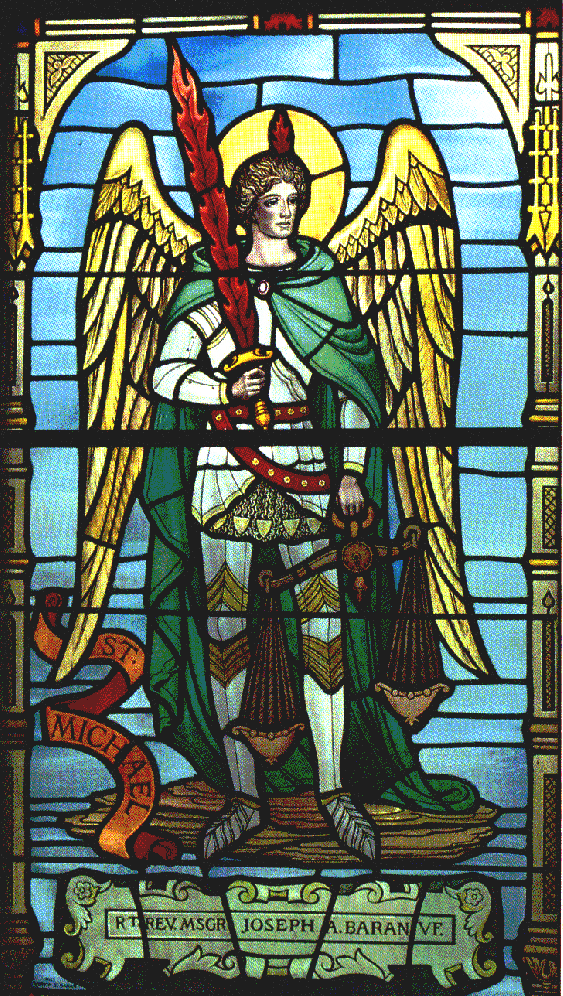
Patron Saint of Police Officers
Sunday, May 25, 2008
Transformation

Thursday, May 15, 2008
Protestant or Catholic - Anglicans Must Decide
From "To All the World..." - Robert S. Munday, Dean of Nashotah House Theol. Seminary
Ruth Gledhill, of the London Times, reports:
"Hard words for Anglicans from the head of the Council for Christian Unity in Rome. Cardinal Walter Kasper has told the Catholic Herald that now, with Lambeth approaching, is the time for Anglicans to decide whether they are Catholic or Protestant. 'Ultimately, it is a question of the identity of the Anglican Church. Where does it belong?' he said. 'Does it belong more to the churches of the first millennium -Catholic and Orthodox - or does it belong more to the Protestant churches of the 16th century? At the moment it is somewhere in between, but it must clarify its identity now and that will not be possible without certain difficult decisions.' The genius of Anglicanism has always been its ability to straddle the divide, but maybe the Cardinal is right and the Communion's present difficulties reflect the impossibility of continuing to do this."
Recovering the faith that was held universally, from antiquity, and by all, is what many of the Reformers believed they were doing in protesting against the medieval innovations and errors of the Roman Church. While the Radical Reformers did not care whether they rejected Rome and catholicity as well, our Anglican forebears were careful to demonstrate that their teaching was in accord with both Holy Scripture as it was understood and interpreted by the early Church Fathers and Councils of the undivided (Catholic) Church. So are Anglicans Protestant? Yes, in that our forebears protested against Rome's departure from true catholicity. Are Anglicans Catholic? Yes, in that our forebears always sought to maintain the Catholic Faith--as Vincent of Lerins would have recognized.
Read it all here.
Friday, April 11, 2008
Cain slew Abel, part 2
Gen 4:10 ~ Cain spoke to Abel his brother. And when they were in the field, Cain rose up against his brother Abel and killed him. Then the LORD said to Cain, "Where is Abel your brother?" He said, "I do not know; am I my brother's keeper?" And the LORD said, "What have you done? The voice of your brother's blood is crying to me from the ground.
We discussed last time that Cain’s first wrong was that he most likely did not take as much care in his choice of offerings to God. His second wrong was that he refused to take responsibility for his own actions. According to the text, his next two wrongs were these: that he used his brother’s trust to lure him to a field, and that once they were there, he killed his brother. Finally, instead of confessing his crime to God, he hid the whole business.
I would like to deal with Cain’s question, “am I my brother’s keeper?” The world tells us that we need only think of ourselves, and the only thought that we should give to others is to keep up with their successes so that we might do better. The fact of the matter is that the answer to Cain’s question is yes, we are our brothers’ keepers. The Law of Moses required land-owners to leave the edges of their fields un-harvested in order that the poor would have something to eat, among other things.
Our Lord had a few things to say on this as well:
When the Son of Man comes in his glory, and all the angels with him, then he will sit on his glorious throne. Before him well be gathered all the nations, and he will separate people one from another as a shepherd separates the sheep from the goats. And he will place the sheep on his right, but the goats on the left. Then the King will say to those on his right, 'Come, you who are blessed by my Father, inherit the kingdom prepared for you from the foundation of the world. For I was hungry and you gave me food, I was thirsty and you gave me drink, I was a stranger and you welcomed me, I was naked and you clothed me, I was sick and you visited me, I was in prison and you came to me.' Then the righteous will answer him, saying, 'Lord, when did we see you hungry and feed you, or thirsty and give you drink? And when did we see you a stranger and welcome you, or naked and clothe you? And when did we see you sick or in prison and visit you?' And the King will answer them, 'Truly, I say to you, as you did it to one of the least of these my brothers, you did it to me.'
"Then he will say to those on his left, 'Depart from me, you cursed, into the eternal fire prepared for the devil and his angels. For I was hungry and you gave me no food, I was thirsty and you gave me no drink, I was a stranger and you did not welcome me, naked and you did not clothe me, sick and in prison and you did not visit me.' Then they also will answer, saying, 'Lord, when did we see you hungry or thirsty or a stranger or naked or sick or in prison, and did not minister to you?' Then he will answer them, saying, 'Truly, I say to you, as you did not do it to one of the least of these, you did not do it to me.' And these will go away into eternal punishment, but the righteous into eternal life." Matt 25:31-46 (ESV)
The only conclusion to be gleaned is that we are, indeed, our brothers’ keepers. The purpose of one man’s strength is to lift up his neighbor who is weaker…or less strong if the word weak offends your sensibilities. To quote Mel Gibson’s character, William Wallace, in the movie Braveheart while speaking to Robert the Bruce, “You believe the people exist to provide you with possession, but I believe your possession exists to provide the people with freedom.” This is a specific way of lifting up our brother, but you get the point. Here’s another: “much is expected of those to whom much is given.” These are both ways of saying the same thing: the things we have – possessions, talents, blessings – are given to us so that we might pass them on to those who do not have them.
Peace,
Jerry
<><
Cain slew Abel, part 1
The second chapter of Genesis tells us the story of Cain and his brother, Abel. We know that Cain was born first, followed by Abel. We also know that Cain was a farmer and that Abel was a shepherd. The biblical text continues to tell us that Cain brought to God an offering of the “fruit of the ground,” and Abel brought an offering “of the firstborn of his flock and of their fat portions.” God looked favorably on Abel’s offering but not on Cain’s. Of course, the first question is, “Why?” Why did God find favor with one and not the other? I think one possible answer lies in the words themselves. Cain brought an offering of the fruit, but Abel brought an offering of the firstborn and of their “fat portions.” This might imply that Abel brought the best of what he had while Cain was less discerning with his offering.
Cain was angry and jealous. He was angry that he had been embarrassed by his younger brother, and he envied the favor that his brother had received from God. What God says next (Gen 4:6-7) is very important, “Why are you angry, and why has your face fallen? If you do well, will you not be accepted? And if you do not do well, sin is crouching at the door. Its desire is for you, but you must rule over it.” Could it be that he was angry with himself? This is entirely possible; however, in true human fashion, he could not allow himself to take responsibility for his own actions. He could not possibly be to blame for his falling short. It had to be someone else’s fault. It had to be Abel’s fault. Abel stole God’s favor from him.
This has particular significance in today’s society. We live in a culture in which no one wants to assume responsibility for his/her own actions. People blame restaurants for their spilling hot coffee in their own laps. Burglars sue homeowners when they are injured in the commission of their crimes. Many blame their parents for their crimes – mom and dad didn’t show enough attention, or they gave too much. Rapists and pedophiles blame their victims. People who choose “alternate lifestyles” blame genetics. Oh, but if only it ended there….Juries award millions of dollars for “butter fingers” and clumsy crooks. Psychologists encourage the idea that mom and dad can be to blame for the crimes of the son. We the people are quick to judge a woman or girl who might happen to dress provocatively or act with less than perfect moral purity as though she might have caused the brutal and dehumanizing attack on herself. I think one reason many people are so willing to believe all these things is that if they are true, then maybe we are not responsible for our own shortcomings.
Notice in the biblical text that there is no mention of the role of Adam and Eve in the actions of Cain when he chose his offering to God. It does not tell us that Eve neglected Cain in favor of his brother, causing a festering jealousy of Abel waiting to be triggered by one too many rejections. It does not say that Adam physically abused Cain, bringing a great anger in Cain waiting to be triggered by being out-shone by his brother. The lesson in these two verses is that we are responsible for our own actions. If we do well, will we not be accepted? And if we do not, is it not our own shortcomings that we are responsible for overcoming? Did we try hard enough? Did we give it our all? Were our efforts in line with the will of God?
The bad news is that we have to accept the guilt for the things we do. The consequences of our actions are our own. The good news is that once we do this, the Bible tells us that we can turn our guilt over to God. The good news is that our debt has already been paid. If we confess to (agree with) God that we have sinned (done wrong) and believe that God sent His Son, Jesus Christ, to die in our place, then we will be forgiven of our sins and receive eternal life. The problem with today’s society is that the common belief is that “it is someone else’s fault.” Instead of accepting and dealing with our sin, we find ways to rationalize it.
The next question that often arises is “how could you be so narrow-minded as to believe that Jesus Christ is the only way to heaven?” I would answer this question with one of my own. Knowing that God has said the penalty for sin is death, why would He offer us a way of salvation at all? And given that God is willing to offer us a way of redemption, why would He not have the right to determine what that Way will be? The fact is that He did not have to offer us a way at all. He could have made us to lie in the bed that we have made, but He made a way for reconciliation instead. He basically said, “you deserve death, but I will give you a way out.” One only has to look at the scriptures to see that God has historically been very specific in His instructions to His people. God told Abraham to sacrifice his son, Isaac, on Mt. Moriah before providing a ram to be sacrificed in his place. God gave specific instructions to the Israelites during the Passover in order for them to avoid the fate of the Egyptians – they were to sacrifice a lamb and spread its blood over the doors of their houses. God gave specific instructions in the Law of Moses concerning not only sin, but also day-to-day living. Why would we think that He would be any less specific with His instructions on salvation? God said that we would die for our wrongdoings, but He provided a Lamb to be sacrificed in our place.
To be continued…
Peace
Jerry
<><
Tuesday, March 11, 2008
Translations and Theology - Fr. Robert Hart
from The Continuum
"I was responding to a comment in another post, and realized that this subject justifies a bit more than one blog comment. We will begin with the comment I was writing in response:
Raphael wrote:
[The Douay-Rheims translation] has been in use since its first edition in 1610. It is a near as possible word-for-word translation of the Latin Vulgate, being the work of St. Jerome (342-420). St. Jerome's work is a careful, word-for-word translation of the original texts.
We do owe a lot to St. Jerome, but here we see a need for better scholarship than was possible in his age. 1 The traditional translation of the First commandment provides a splendid example of what I mean.
My own literal translation of the first commandment, directly from the Hebrew with the original syntax, goes like this:
"No having to you other gods over the face."
This translation is absolutely exact, and it makes no sense. Now, the word I have translated literally as "over" means, by implication, "in front of." This can be summed up in one word: "Before;" that is, as long as we understand that "before" means "in the presence of." Now, from the original, we have a problem. Does the commandment mean, "No having to you other gods before your face," or "before my face," in line the accepted standard translation ("before Me")?
The traditional translation is drawn from the larger theological understanding that God's presence fills the whole earth, and indeed, all creation. And so, the translation, "Thou shalt have no other gods before me," requires this added revelation, termed by theology as omnipresence. Also, the distinction between having other gods, and having idols, is a distinction between the first and second commandment that helps us learn the subtle difference between a false god and an idol. This may not have been as clear in the days of Moses as it would be later. The Gnostics did not have literal idols, but rather false gods by definition. The ultimate false god that has no idol, that is, no image before which the devotee bows in worship, is the god of Mohamed.
The traditional rendering of the first commandment, consistent with the Latin translation (The Vulgate) is quite helpful in one respect, and not at all helpful in another. By helping us to see that worship of any other god is a sin even without an idol (as would be lost with our alternative option, “before your face”), we are able to grasp the fuller meaning of scripture. It is just as wrong to worship conceptual gods, as Marcion and Mohamed proclaimed, as it is to worship a deity represented by an idol. Unfortunately, the same customary translation that helps us in this respect also fails us by combining the first and second commandment into one commandment (followed by the equally mistaken custom of dividing the tenth commandment into two separate commandments), weakening the strength of this teaching. This was corrected by the Church of England, both in its very first Book of Common Prayer and in the early translations of the Bible into English
Raphael wrote also:
For this reason [by which he refers to what he said about the Vulgate], the Douay-Rheims is considered the definitive translation.
I prefer the translation of 1611. "Translated out of the original tongues, and with the former translations diligently compared and revised, by his Majesty's special command." The translators were aided by their use of the original Hebrew and Greek texts. On the other hand, their conservatism kept them from making arbitrary and radical changes in traditional meaning. Without the second part, their diligence in comparison to former translations, they may have felt free to use translation as an excuse to be overly creative. That is, not that accurate translation would have been the problem, but the feeling and assumption of poetic license. This presumption of too much authority by some modern translators has led to utterly false renderings. In a previous article, I provided the following example (about the first error in one of the worst versions of the Bible available in English):
“ The first mistranslation in the NRSV (New Revised Standard Version) combines the first two verses of Genesis into one sentence, adding wrongly the word 'when,' as if the world existed before God’s creation. ‘In the beginning when God created the heavens and the earth, the earth was without form…’ The Hebrew simply does not justify this ‘translation’ ... The first two sentences are not joined in the original Hebrew. The older “And, the earth was without form and void...” is literally correct, and it cannot be used to suggest Pantheism.”
The mistranslation I cited has become quite trendy among people who seem bent on trying to destroy the revealed doctrine of creatio ex nihilo, and so the NRSV is not the only example of this particular abuse. The problem here is either one of deliberate mistranslation, or an exaggerated regard for poetic license. Either way, it flies in the face of the two things that steered the translators of The Authorised Version (the King James). It would have been prevented by a sincere principle to “translate out of the original tongues" added by the second principle as a safeguard, namely, “and with the former translations diligently compared and revised.” What marked the King James as setting the standard for Bible translation was that combination of accuracy and humility. Accuracy of language and meaning, aided by the humility to learn from the work of past generations. Furthermore, this requires both an education in languages and in theology.
1.About St. Jerome, here is an interesting passage from a book. “'The flesh I might try to break with frequent fasting: but my mind was seething with imagination: so to tame it, I gave myself up for training to one of the brethren, a Hebrew who had come to the faith. And, so after the subtlety of Quintilian, the flowing of Cicero, the gravity of Fronto and the gentleness of Pliny, I began to learn another alphabet, and meditate on words that hissed and words that gasped' The final vintage was to be the Vulgate translation of the Old Testament: he was still working on Hebrew in his old age.”Helen Waddell, The Desert Fathers, (New York, 1998), p.33"
Conversion vs. Surrender
I have been debating with myself over the differences between conversion to Christianity and surrender to Christ. Are there differences between them, and if so, what are they?
I would begin by defining the difference between conversion and surrender as the difference between “head knowledge” and “heart knowledge” – the difference between learning the truth and KNOWING the TRUTH. When we hear about the Lord Jesus, and accept that it is the truth, that He is the Truth, we are converted. Does surrender also happen at this time? I am sure that it does in some cases, but not in all. It is true that conversion involves surrender to a degree, more with some than with others. We surrender to the knowledge that we cannot be our own saviors. We surrender to the knowledge that Christ Jesus is our only hope of salvation. To say that we recognize the surrender of control of our lives to His divine direction would be to get ahead of ourselves, however, because most do not. We all have our little “secreted” things, which we try to keep to ourselves. It is human nature to wish to be in control, and to fight “tooth and nail” against losing control in even the smallest measure.
But what would it look like if one were to fully surrender one’s life to the Lordship of Christ? As much as I would like to say “this” or “that,” I cannot because, as much as it pains me to say, I cannot honestly say that I have completely given my life over to the Lord. Every day the Holy Spirit shows me something of my old life to which I am clinging. Every day He convicts me of something to which I keep to myself. Every day I hear myself saying, “Yes, Lord, I want to, but I cannot,” or “Yes, Lord, I want to, but I do not know how.” Do I want to reach that maturity of faith, which leads to total surrender? Do I continue to grow and come closer? Do I believe that I will one day attain that ideal relationship with my Lord? Yes to all three of these. How long will it take? Maybe the rest of my life, but it will be worth it in the end.
Protestants emphasize evangelism, witnessing to those who do not know the Lord in order that they might be “saved.” Unfortunately, their focus usually ends here. Once they have seen that the convert has professed faith in Christ and is baptized, they move on to the next lost soul in order that he might find salvation. Many new Christians are left floundering in the dark, not knowing which way to turn. Many even fall away from religion, thinking it unnecessary. This truly is a shame – these “baby” Christians never mature in the faith. They never graduate from the “milk” of the Gospel to the “meat” of the word. They spend the remainder of their lives in a holding pattern, never really understanding the possibilities of a full, knowing, loving relationship with their newly found Savior.
While some Catholics understand a mission in evangelism, the majority of Catholicism concentrates on Catechizing the converted, or the children thereof, in the ways of the Church. Again this presents a problem in that, should a “seeker” find the Church, they do not tend to receive the totality of teaching required to reach maturity in the faith, not to mention that the concept is lacking on the other end of the spectrum from the Protestants. Again this leads to a falling away from the church by many, if not most.
My point is that, without continued education, new Christians cannot know enough to lead them to the point of spiritual maturity required for full surrender to Christ. In order to KNOW Him, we must know OF Him. But we cannot stop with simply knowing of Him.
Anyone with any experience in most mainline Protestant churches will recognize the term “altar call.” For those who do not, I will offer a brief explanation. After a hearty and sometimes emotional sermon, the pastor will usually call for any who wish to accept Christ as Savior. Accompanying his pleas, the choir, and oft times the congregation, will sing an “Invitation Hymn.” One of my favorites was “I Surrender All.” It is in part petition and in part a great profession of faith, but it speaks to the type of surrender of which I speak. May we all come to surrender to our Lord and depend upon Him, trusting that He will never lead us astray.
Jerry
<><
PS. I've added the lyrics below, as well as a link to a new rendition by a popular "Christian artist."
I Surrender All
All to Jesus, I surrender;
All to Him I freely give;
I will ever love and trust Him,
In His presence daily live.
Refrain
I surrender all,
I surrender all,
All to Thee, my blessèd Savior,
I surrender all.
All to Jesus I surrender;
Humbly at His feet I bow,
Worldly pleasures all forsaken;
Take me, Jesus, take me now.
Refrain
All to Jesus, I surrender;
Make me, Savior, wholly Thine;
Let me feel the Holy Spirit,
Truly know that Thou art mine.
Refrain
All to Jesus, I surrender;
Lord, I give myself to Thee;
Fill me with Thy love and power;
Let Thy blessing fall on me.
Refrain
All to Jesus I surrender;
Now I feel the sacred flame.
O the joy of full salvation!
Glory, glory, to His Name!
Refrain
Friday, January 18, 2008
Love Your Neighbor as Yourself...
Matt 22:36 Master, which is the great commandment in the law? 37 Jesus said unto him, Thou shalt love the Lord thy God with all thy heart, and with all thy soul, and with all thy mind. 38 This is the first and great commandment. 39 And the second is like unto it, Thou shalt love thy neighbor as thyself. 40 On these two commandments hang all the law and the prophets.Easy, right? Really? As stated by Jesus, these two commandments are the summation of the Law and the prophets, and as we know the law was given to show man his sin. We are not meant to be able to follow the law in and of ourselves. In fact, there has been only one person who has kept the law perfectly…Jesus the Christ. Following this logic, we cannot love God with all our hearts, souls, and minds without help from Him. Just as the gift of God’s grace gives us the desire and ability to believe unto salvation, that same grace gives us the ability to agapaō God with all our hearts, souls, and minds. What about the mandate that we are to agapaō our neighbor as ourselves? The same must, of course, apply. I would add to that the following: one cannot love his neighbor as himself unless he loves God with all his heart, soul, and mind; and one cannot love God with all his heart, soul, and mind without loving his neighbor as himself.
Do I love my neighbor as myself? I certainly try, but I will be the first to admit that I find difficulties in that from time to time. What does that say about my love for God? I think it means that while God has begun a good work in me, it is not yet finished. I am a work in progress. Do I love God? Emphatically, yes! Is it the perfect love that He demands? Sadly, no. How can I, an imperfect being, have perfect love? As I said, God gives the ability, I try, and eventually God will help me (allow me?) to get it right.
Lord I believe…please, help my unbelief!
Jerry
<><